A Turbulent Country
Protests, repressions, local conflicts, and civic initiatives — from Biryulyovo to Buenos Aires. This selection features everything captured by Lenta.doc's cameras: pogroms, rallies, environmental strikes, protests by scientists, scholars and schoolteachers, anti-fascist marches, and the voice of discontent, ringing out in many different forms.
 Olga Romanova supports her husband at his parole hearing
Olga Romanova, Boris Nemtsov, and other supporters attend a hearing at the Ivanovsky District Court concerning the parole request of Romanova’s husband, businessman Alexei Kozlov. Nemtsov criticizes the case against the entrepreneur, calling it an example of “a corporate raid carried out with the support of the security services,” and links the prosecution to a business dispute over the Iskozh enterprise and the interests of former senator Vladimir Slutsker. He emphasizes that the investigation appeared biased and was conducted with numerous procedural violations. Nemtsov also draws attention to a conflict of interest, noting that Andrei Babushkin, a member of Moscow’s Public Monitoring Commission (ONK) who had visited Kozlov in pretrial detention, should not have any ties to commercial entities potentially involved in the case: “It’s a textbook conflict of interest — being the chairman of the board of a fund factory and at the same time a member of the ONK. He’s essentially overseeing himself. That’s corruption.”Nemtsov’s point was that a person connected to a business structure (Fondzavod / Fondservis) while simultaneously serving on the ONK creates a situation of potential corruption through conflicting interests — a claim used by Kozlov’s defense as evidence of systemic bias.
4 minutes Activists from the Moscow Dormitories movement chain themselves together
In February 2013, about thirty activists from the Moscow Dormitories Movement and an initiative group of large families on the waiting list came to the Department of Housing Policy, dissatisfied with the fact that they had been removed from the housing waiting list on dubious grounds. They claimed that they had been excluded by having the living space of relatives or long-dead parents “attached” to them, and that they had been deprived of subsidies. Among the activists was Yekaterina Maldon, who lived with her four children in a dilapidated 14-square-meter communal apartment.
When officials refused to let the group proceed beyond the lobby, two protesters handcuffed themselves to the railings inside the building. The police called in a lock smith to remove the chains, after which the activists were detained and taken away in a police van, as they refused to leave voluntarily. Several more people were detained on the building’s front steps on charges of “petty hooliganism.” The protest ended without resolving the activists’ housing problems, but it did draw public attention to the issue and generated significant media coverage.
4 minutes Detention of an opposition newlywed couple on Triumfalnaya Square
Newlyweds end up in a police van on Mayakovsky Square, not having had time to sign the marriage certificate.
3 minutes Aleksandr Dolmatov's friends at his mother's house
Alexander Dolmatov was an active participant in the 2012–2013 protests and was detained in connection with the Bolotnaya case. He was forcibly sent from the police station to a psychiatric hospital. After his release, he fled to the Netherlands but complained of being persecuted by the special services. The Dutch authorities denied him political asylum and placed him in a deportation center, where he was later found hanged. Lenta’s report looks at how his relatives have lived since his death — how they received condolences from the Queen of the Netherlands and fended off intrusive reporters from NTV. “There’s no place here for bright people. For those who think, who reason. They’re afraid of them,” says one of Dolmatov’s relatives.
4 minutes At the March Against Scoundrels
Opponents of the so-called “Law of Scoundrels” (Magnitsky Act) took to the streets carrying portraits of State Duma deputies. In the campaign headquarters, activists joke about a crookedly pasted poster with Putin’s face: “Stuck on like a bathhouse leaf — no one will be able to peel him off now.” Pensioners sort through placards reading “Shame on Rodnina!”, “Shame on Mironov!”, “Shame on Zhirinovsky!” — everyone has their own “favorites.” One elderly woman hesitates before taking a sign that says “Anatoly Lokot,” sighing: “Well, I’ll take some Lokot at least.” Another remarks, “They’re all from the same place anyway.” “Damn you all, bastards,” others echo. With chants of “Shame on the scoundrels!” and “We are the power here!”, the column moves down the street. Participants then theatrically throw the portraits of the deputies into trash cans. A poster bearing Putin’s image is trampled underfoot — “It won’t wash off,” someone remarks; soon after, however, the soiled portrait is asked to be removed from the frame.
5 minutes Activists break into the dormitory
In 2013, activists from the Moscow Dormitories Movement and the anti-fascist movement broke into one of the departmental dormitories to prevent the eviction of several families. According to the participants, the residents were being evicted without being provided with alternative housing, despite their long-term residence and permanent registration. The activists claimed that the dormitory had been illegally transferred to a commercial fund and that the new owners were seeking to vacate the premises through the courts.
4 minutes Ilya Yashin and Boris Nemtsov at the March Against Scoundrels
Russian opposition figures Ilya Yashin, Boris Nemtsov, and others take part in the "March Against Scoundrels". Yashin is against carrying posters depicting the faces of State Duma deputies who voted in favor of the law. The march ends, and Nemtsov leaves the sign “as a keepsake.”
3 minutes March in honor of the fourth anniversary of the murder of lawyer Stanislav Markelov and Novaya Gazeta journalist Anastasia Baburova
On January 19, an annual anti-fascist march took place in Moscow in memory of lawyer Stanislav Markelov and journalist Anastasia Baburova, who were murdered in 2009. The event was approved by the authorities only after a compromise: participants agreed to refrain from carrying posters in order to avoid clashes with riot police and prevent tension. The organizers emphasized that this formal restriction did not change the essence of the march: its purpose was to preserve the memory of the victims and protest against the growing influence of nationalism. Participants stated that despite the killers having been punished, nationalists continue to enter politics and incite further violence. The march concluded with the laying of flowers at the site of the murder on Prechistenka Street.
2 minutes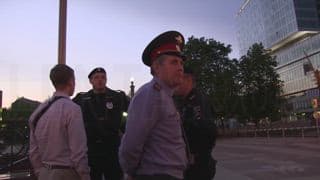 Mass arrests on Trubnaya Square in Moscow
Arrests on Trubnaya Square in Moscow occuring during a protest. Police conducted mass document checks, after which people were forcibly taken into police vans for inspection. The incident was part of a larger campaign to suppress street protests in Moscow in the early 2010s.
3 minutes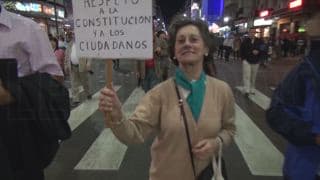 Political demostration for human rights in Buenos Aires
The political demostration in Buenos Aires, aimed at defending democratic rights and freedoms. This took place against the backdrop of mass protests around the world in the 2010s, including protests against economic inequality, corruption, and authoritarianism.
3 minutes